

Corrosion Growth Rate (CGR) Assessment for a Major Pipeline System using THEIA Pockets
Project Background
A major oil storage and transshipment terminal in the Europoort area of Rotterdam handles around 35 million cubic metres of crude oil annually, accounting for a quarter of the region’s throughput and supplying both domestic and international markets.
To ensure the safe and efficient operation of its 325 km pipeline network, Penspen was commissioned to optimise the in-line inspection (ILI) strategy, focusing on the areas most at risk of integrity threats.
A key part of this work involved assessing Corrosion Growth Rates (CGR) by tracking pipeline anomalies across multiple ILI datasets. With thousands of potential anomaly matches, a digital analytical approach was essential to deliver accurate, reliable insights and support proactive pipeline management.
Services
The assessment was performed using THEIA, Penspen’s digital integrity management platform.
Initial feature matching identified a low correlation between inspection datasets, with only 19% of external corrosion features matching between ILIs. While weld alignment appeared accurate, the low match rate resulted in abnormally high calculated CGRs, prompting further investigation.
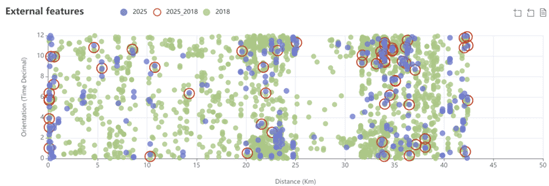
Figure 1: THEIA’s Feature Matching showing poor matching results (19%) between two ILIs
To gain deeper insight, Penspen engineers utilised THEIA Pockets™, a built-in capability that allows custom Python-based analyses to be integrated directly into THEIA.
For this project, the Segmented CGR Pocket was deployed to:
- Identify matched and unmatched corrosion features
- Calculate linear CGR for each anomaly
- Visualise corrosion growth along the pipeline
- Detect outliers and potential new corrosion growth
The analysis highlighted several significant anomalies, including corrosion up to 64% wall thickness that had not been matched in previous datasets, suggesting newly developed corrosion features.
The pocket also applied a density grouping algorithm to identify clusters of corrosion activity and calculate maximum, average, and 95th percentile CGR values across defined pipeline segments. This enabled engineers to determine the Applied CGR, a realistic corrosion growth rate for specific sections of the pipeline.
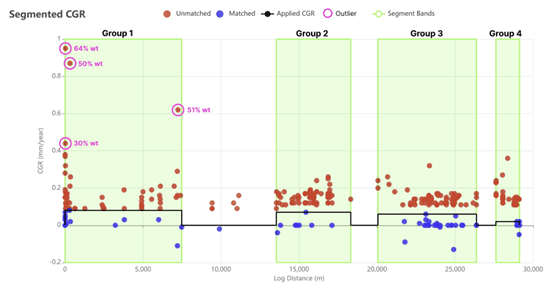
Figure 2: CGR for Each External Corrosion Anomaly on the Pipeline for the Matched (Blue) and Unmatched (Red) Features
Result
Using THEIA Pockets™, Penspen was able to uncover critical insights that were not visible through standard analysis. The assessment identified gaps and inconsistencies in the previous ILI vendor’s data, highlighted corrosion anomalies that had not previously been matched between inspections, and pinpointed areas of highest integrity concern along the pipeline.
By applying advanced feature matching and segmented CGR analysis, Penspen delivered a more accurate understanding of corrosion growth behaviour and provided the client with clear, data-driven guidance on where to prioritise inspection, monitoring, and integrity management efforts.
- Explore more of THEIA’s advanced analytics and capabilities here.
Related Projects
Corrosion Growth Rate (CGR) Assessment for a Major Pipeline System using THEIA Pockets
Discover how Penspen used THEIA Pockets™ to enhance Corrosion Growth Rate (CGR) analysis across a major European pipeline network, uncovering previously unmatched corrosion features and...
Integrity Assessment of the Los Ramones Phase II Natural Gas Pipeline in Mexico
Sempra Infrastructure selects Penspen for Integrity Assessment of Los Ramones Phase II – North Pipeline in...
Integrity Consultancy Services for 100+km European Crude Oil Pipeline
Penspen awarded five-year framework agreement extension to strengthen Europe’s pipeline...
Informed Pipeline Integrity Management Planning in Chile using THEIA, Penspen’s Digital Integrity Management Solution
Penspen has successfully provided technical advice to a Chilean client on a range of mechanical integrity disciplines to ensure the integrity and reliability of a 2,000km long transportation system...