


Pipeline Network Performance Using Machine Learning
An extensive water pipeline network consisting of several interconnected pipelines supplies water to various pump stations. The system has been in place for many years and has experienced serious issues with corrosion/erosion and below-expected flow rate delivery at various points in the system. To help understand the potential causes, flow meters at various points were installed to gather data. Penspen’s scope was to develop a model of the network to enable the efficient assessment of the network performance. The work was executed by the Centre of Engineering Excellence (CEE).
Initial Assessments
Initial data assessment of the flow meters suggested lower than expected flow, with at least one pipeline almost entirely blocked. The usual method is to develop a flow assurance model and perform simulations to assess the network performance. The challenge in undertaking performance analysis of this system is obtaining a complete set of input data in the form of boundary conditions for the 3 inputs and 9 outputs and dealing with the continuously changing conditions with start-ups and shutdowns of individual pump stations.
Machine Learning Overview
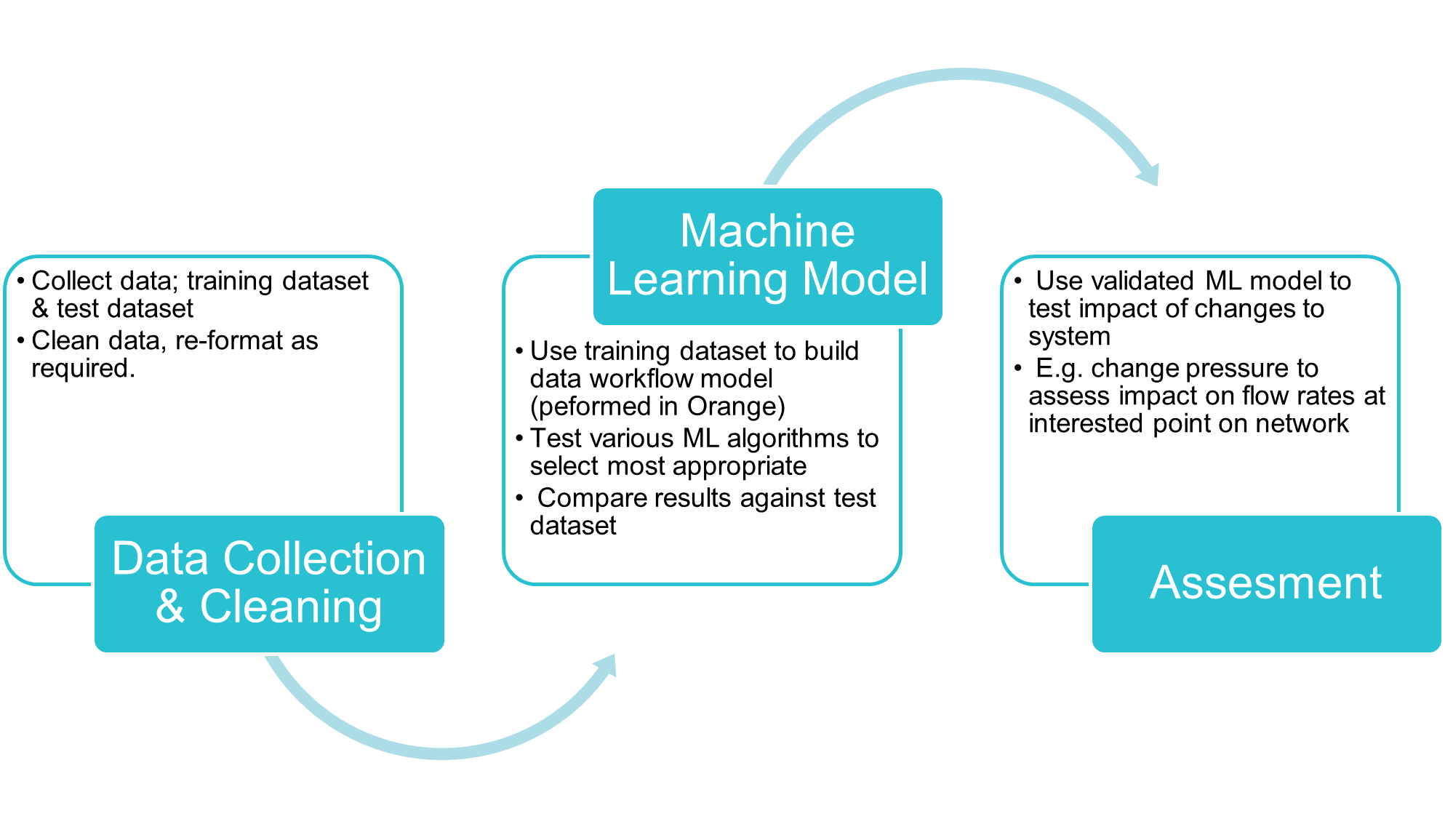
As an alternative, the flow rate data already gathered was used to develop a machine learning model of the system. Use of machine learning algorithms to build a model of the system that predicts outputs based on inputs. Machine learning algorithms are used to build a model based on sample data, known as “training data”, to make predictions or decisions without being explicitly programmed to do so. The model was used on two datasets: before and after installation of additional equipment, with the former used as the training data and the latter as the test data. Air valves were installed and flow rate data before and after their installation was available. This approach allows for a significantly faster method to assess changes to the system to determine potential causes & also assess the impact of mitigation measures. Another benefit is that it does not need a full data set, though more data will increase the accuracy. This can be particularly advantageous where only incomplete input data is available, which can be the case with aging assets.
Machine Learning Model
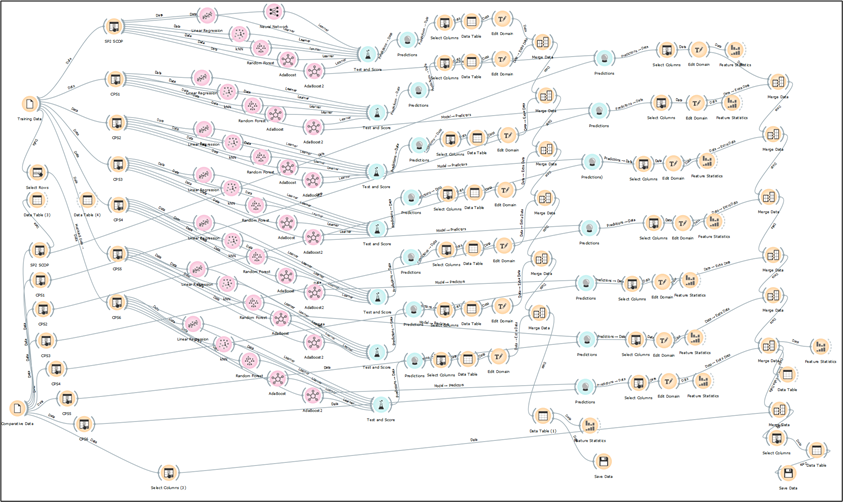
For this study Machine learning was performed using Orange software. Orange is a component-based visual programming software package for data visualization, machine learning, data mining, and data analysis. Visual programming is implemented through an interface in which workflows are created by linking predefined or user-designed widgets. A bespoke workflow was developed for this project – see figure below.
Model Testing
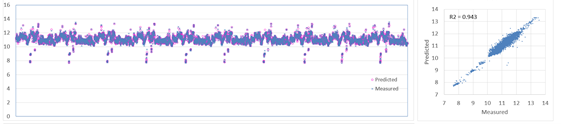
Model testing yielded good results. Individual plots of measured and predicted, and unity plots were created at each pump station location, an example is shown below.
Run with Test Data
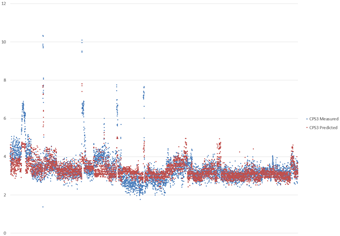
The validated machine learning model was subsequently run with input data from the test dataset. The comparison of predicated and measure data points at a particular location are shown below.
Conclusion
The machine learning methodology proved to be an accurate and efficient method for comparing performance. It has the advantage of not needing a complete dataset and relatively straightforward to set up. This allows for fast evaluation of results to changes in inputs to identify trends to assess network performance. As more data is gathered over life, this can be added to augment the model and improve accuracy. The model maintenance requires minimal effort, yet provides a close.
This work was performed by Penspen’s Centre of Engineering Excellence (CEE), which provides advanced analytics and simulation services as one of their main offerings. To find out more information on the performance of pipelines and our capabilities at the CEE, email our Executive Vice President, Technical Excellence, Nigel Curson.
Insights & News

Learning, Growing, and Contributing to UAE’s Energy Future: Our People – Shorouq
From academic excellence to real-world impact, Shorouq is building her engineering career through Penspen’s Emirati Graduate...

Youth Building the Future: Jose Luis’ Journey at Penspen
As Human Resources Assistant at Penspen, Jose Luis is helping to strengthen our capability, support our employees’ professional growth, and ensure our teams are equipped to meet the demands of a...
Curiosity, Commitment, and Corrosion: Our People – Yureis Villasmil
Passionate about personal development, integrity engineer Yureis shares how her her work contributes to the safe and sustainable delivery of energy throughout Latin America. ...
Development and Implementation of Asset Integrity Management Systems
In the case of facilities, integrity management is somewhat more complex than for pipelines, due to the nature and complexity of these types of assets, which distinguish them from a main...

Penspen Wins Innovation & Digital Award at 7th Grupo Energía Bogotá Supplier Recognition Gala
Penspen recognised by Transportadora de Gas Internacional S.A., Colombia’s largest natural gas operator, with the Innovation and Digital Award at the 7th Grupo Energía Bogotá (GEB) Supplier...
Penspen Asset Management Consultancy: Managing Risk and Compliance Across Asset-Heavy Portfolios
International engineering consultancy Penspen has launched an Asset Management Consultancy, supporting asset-heavy industries looking to protect reliability, improve value, meet regulatory...
Penspen Opens New Newcastle Office to Drive European Asset Integrity Growth
International engineering consultancy Penspen has opened a new office in Newcastle’s Time Central facility as it plans further growth in the European asset integrity market. The new office is home...
More insights
-

Learning, Growing, and Contributing to UAE’s Energy Future: Our People – Shorouq
From academic excellence to real-world impact, Shorouq is building her engineering career through Penspen’s Emirati Graduate Programme.…
Read insight -

Youth Building the Future: Jose Luis’ Journey at Penspen
As Human Resources Assistant at Penspen, Jose Luis is helping to strengthen our capability, support our employees’ professional growth, and ensure our teams are equipped to meet the…
Read insight